
Building Green Made SimpleAn Angiras & Co. guide
An illustrated guide that translates sound green-building science into practical, costed steps for homeowners, renters, community educators, and small businesses, across six climate zones and 500+ cities.
The knowledge exists. The translation didn't — until now.
Most green-building knowledge is locked inside standards, rating systems, and technical papers written for specialists. BGMS keeps the rigour and removes the barrier: every recommendation is weighed against three plain filters before it earns a place on the page.
Can a household actually afford it? Costs are given in real ranges, with payback where it matters, not aspirational figures.
Can it be done without specialist skills or equipment? If a measure needs a professional, we say so plainly.
Does it actually work where you live? Every measure is flagged to the climate zones where it delivers, and to those where it doesn't.
Recommendations are organised by zone, because what cools a home in Jaipur can trap damp in Halifax. Each zone carries its own dominant comfort and indoor-air challenge.
Challenge: rejecting heat while managing moisture, mould, and ventilation.
Challenge: daytime heat and dust; thermal mass and shading do the heavy lifting.
Challenge: mixed seasons; balancing heating, cooling, and fresh air year-round.
Challenge: retaining heat and avoiding condensation in a tight, well-insulated shell.
Challenge: intense sun, cold nights, thin air; thermal mass and solar gain together.
Challenge: hot summers and cold winters; strategies must flex across both.
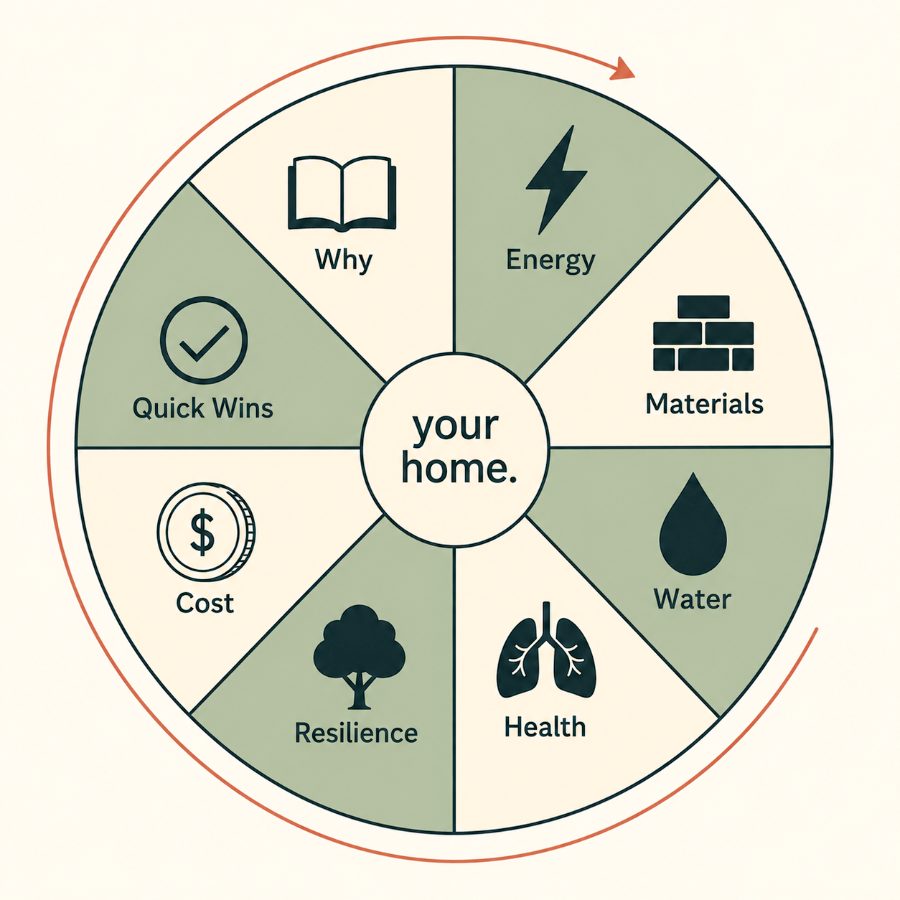
Read start to finish, or jump to the chapter that matches the decision in front of you.
BGMS treats vernacular building as substantive knowledge: naming the tradition, explaining how it works, and drawing the equivalence to modern practice.
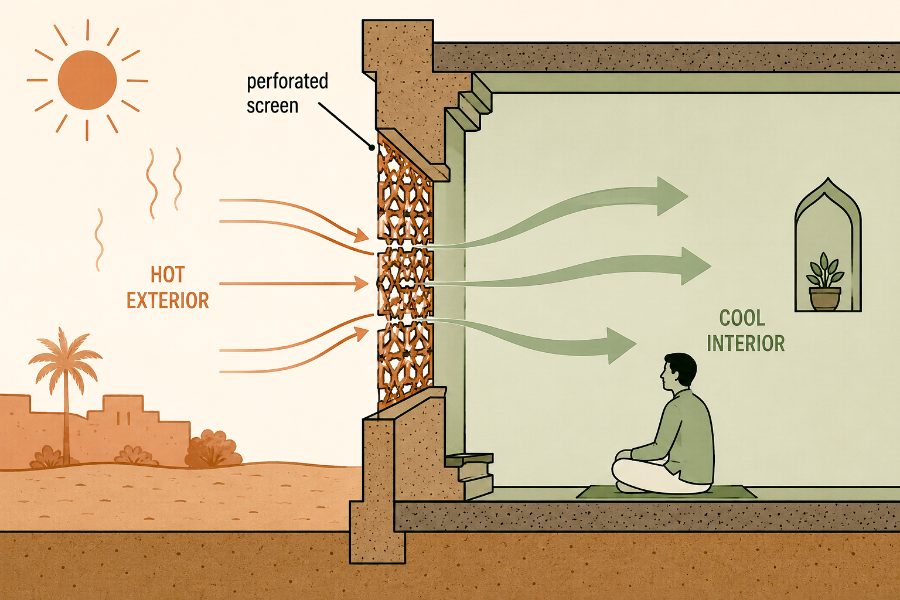
The perforated stone screen accelerates air as it squeezes through each opening. This is the Venturi effect, and it cools the room behind it. Hot-dry, refined over four centuries.
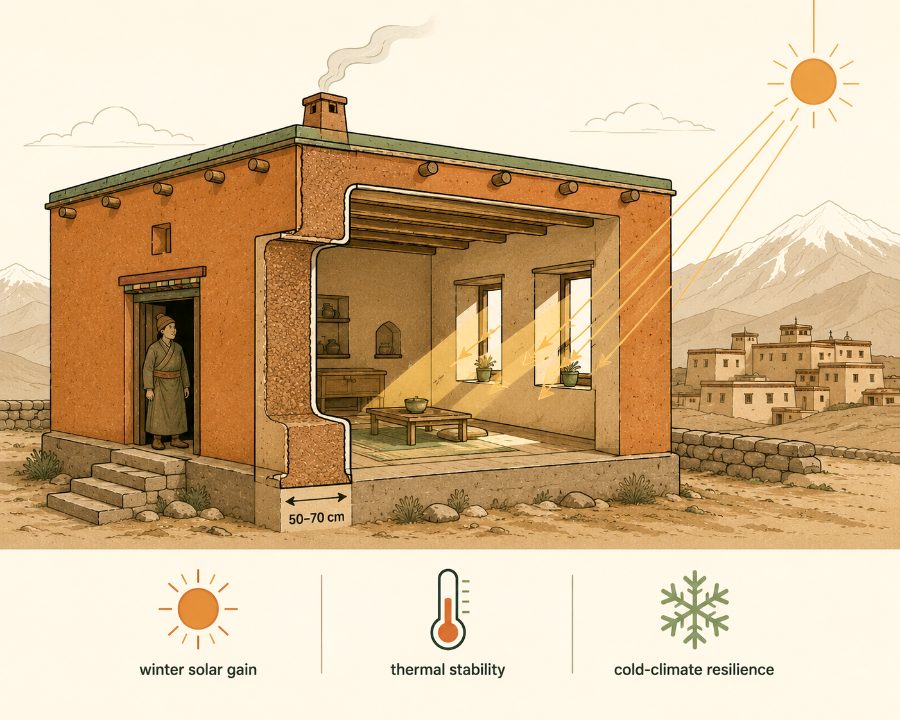
Thick earth and stone walls, the logic of Kath-Kuni and Ladakhi homes, store the day's warmth and release it through cold high-altitude nights.
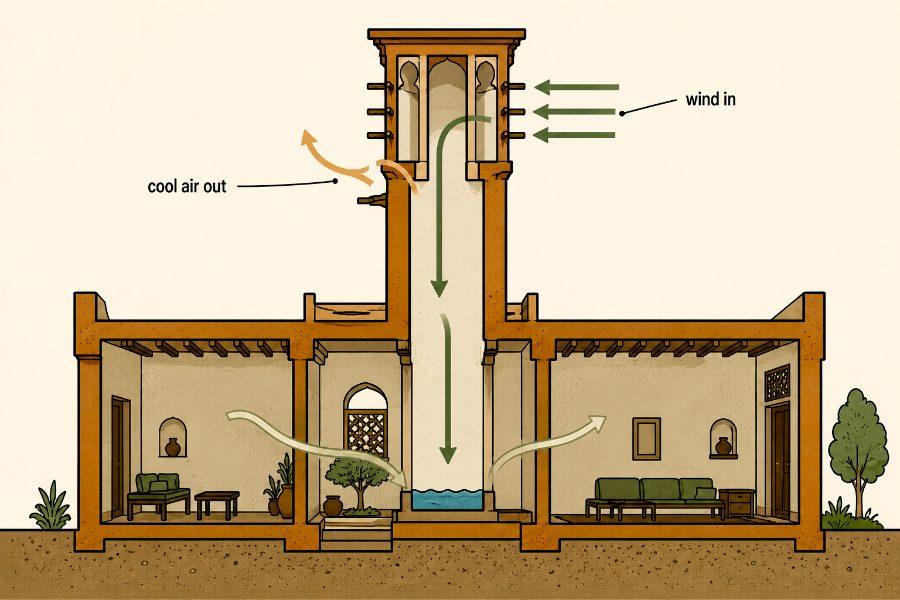
North African courtyards and Persian badgirs move air without power, pulling cool night air down and venting heat by day.
of global energy-related CO₂ emissions come from constructing and running buildings, more than transport.
Source: UN Global Status Report for Buildings & Construction (2023)Buy a CO₂ meter (~$30–80). Leave it in your bedroom for a week. If readings regularly pass 1,000 ppm with the door shut, that room needs ventilation.
Built alongside the guide, with no sign-up and no paywall. They run in your browser at angiras.co/bgms.
Enter your city and get your climate zone, with the comfort challenge to design for.
Open tool →Filter measures by budget, effort, and zone to build a shortlist that fits your home.
Open tool →Estimate how quickly an upgrade pays for itself from the savings it returns.
Open tool →Size a rainwater tank for your roof area, rainfall, and household demand.
Open tool →Suggested citation: Angiras, P. & Sodeiri Jalili, G. (2026). Building Green Made Simple (Version 1.1). Angiras & Co.